
Overview
Project Leads: Newport News Shipbuilding
Project Title: NNS Foundry Casting Improvements
Period of Performance: 08/2019 – 06/2022
Objective
Investigate methods to shield the molten metal to reduce air entrainment and the formation of ceramic oxides.
Benefits/Payoff
Estimated Savings: • $6.5M over 5 years
-Reduce ceroxide formation
-Reduce cleaning room operations
-Reduce defects per part
Implementation
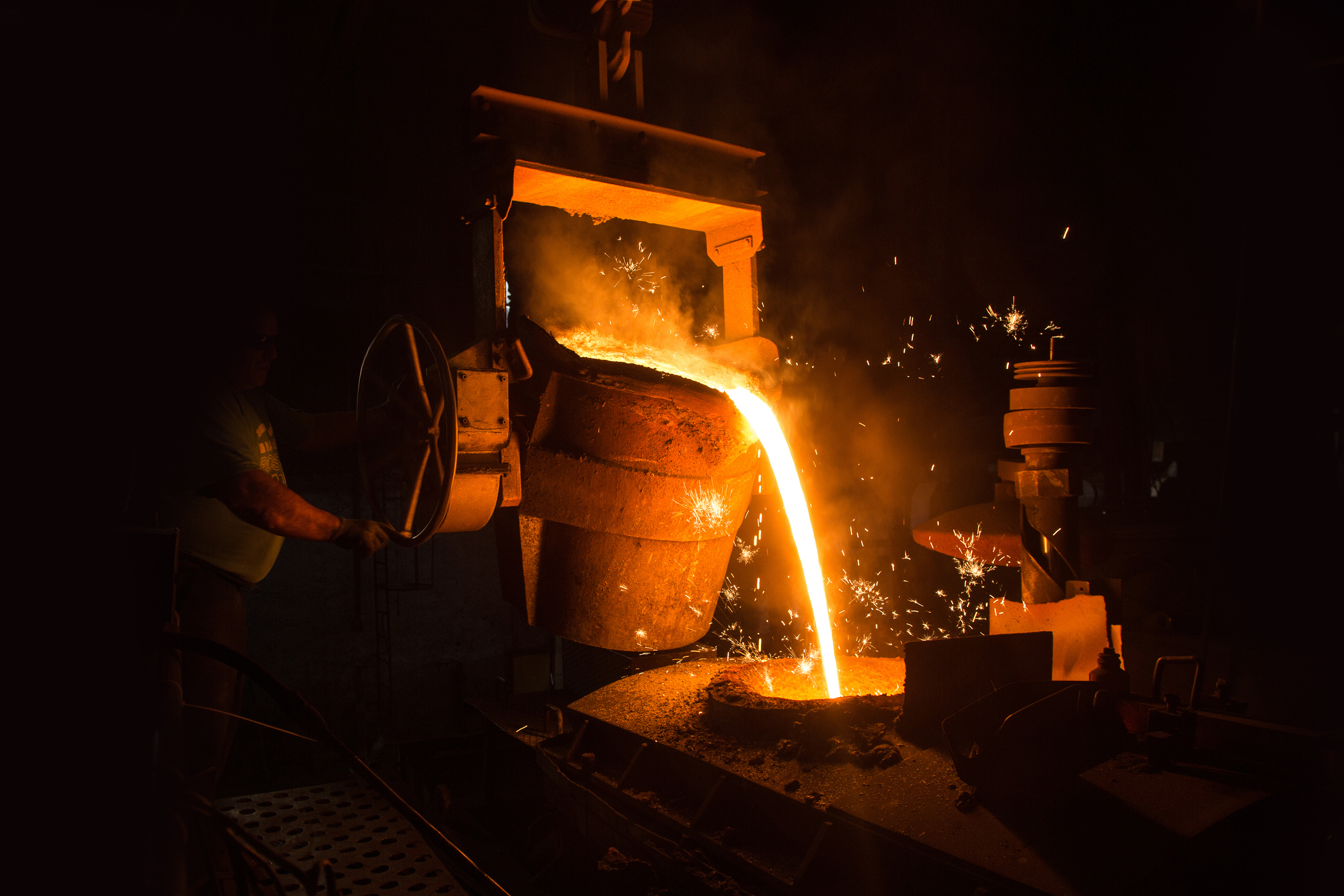
In manufacturing, castings are often used to alleviate fabrication costs by delivering a raw material part with near-net or end-use geometry. This enables manufacturers to minimize or eliminate machining operations to reduce costs. While this process is highly appealing to shipbuilders, the metal caster must ensure that the end product meets the U.S. Navy’s high technical requirements. This, along with the low volume in shipbuilding, makes obtaining a commercial supplier difficult. To obtain casting use benefits, Newport News Shipbuilding (NNS) maintains a foundry (the “Foundry”) to supply castings for all NNS production efforts. However, natural occurring phenomena allows the reactants needed for ceramic oxides to be absorbed into the molten metal during the discrete pouring operation as seen at Newport News Shipbuilding’s Foundry. With the majority of NNS Foundry personnel conducting Cleaning Room activities to repair the ceramic oxide defects (ceroxides), reducing or eliminating the formation of these defects will prove highly beneficial. The NNS Foundry Casting Improvements project aims to incorporate a shroud and tundish design to shield the molten metal as it flows from the melt pot into the mold. Protecting the molten metal will reduce the air entrained from the flow of metal and ensure there is minimal reaction time between the air and molten metal. This project also aims to investigate and advance modeling and simulation programs to predict were ceroxide defects will form in a cast part and the potential to push the ceroxides to desired portions of the cast part. The project will be executed in two phases. Phase I will focus on data gathering and baselining the legacy defect formation at the Foundry. Phase I will also be used to integrate data into the modeling and simulation (M&S) software and validate the modeling software with empirical data. During Phase II, the project team will use the M&S tools to optimize the previous test cases to minimize ceroxide formation. The results from Phase II will result in recommended process and/or design changes for implementation after successful demonstration. Once implemented, the process and/or design change is anticipated to provide a 5-year savings of $6.5M for NNS foundry operations. CNM is a Navy ManTech Center of Excellence, chartered by the Office of Naval Research (ONR) to identify, develop and deploy, in U.S. manufacturing facilities, advanced manufacturing technologies that will reduce the cost and time to build and repair Navy ships and aviation assets. For additional information on this and other CNM projects, please visit https://www.navalmetalworking.org/.
*Prepared under ONR Contract xxxxxx-xx-x-xxxx as part of the Navy ManTech Program.
*DISTRIBUTION STATEMENT A. Approved for public release: distribution unlimited. DCN# xxxx-xxx-xx; Approval Date: xx/xx/xxxx